Key Takeaways
- Start your strategy from a business problem with a price tag, not from a platform.
- Master one domain first, and pick the one with high cost and few source systems.
- Name a business owner and a steward for each domain before you configure anything.
- Track duplicate rate, completeness and time spent fixing records from the first month.
Most master data strategies fail on the first page. They open with a vision of a single customer view across the enterprise and a platform to deliver it. Eighteen months later, nobody can say which records got better. If you want a result you can defend, the master data management consulting work I do starts smaller: one domain, one owner, one number to beat.
This playbook walks through five phases in the order I run them. The overview table comes first, so you can see the whole shape, and each phase then gets its own section with the decisions you have to make.
The Five Phases in Short
| Phase | Main question | Typical output | Typical duration |
|---|---|---|---|
| 1. Prioritize | Which domain costs us most? | Ranked domain list with a business case | 1 to 2 weeks |
| 2. Assign ownership | Who decides what a correct record is? | Owners, stewards and a decision process | 1 week |
| 3. Define the golden record | Which fields, which rules, which source wins? | Data model, match rules, survivorship rules | 2 to 4 weeks |
| 4. Choose the delivery path | Do we need a platform, and which style? | Tool decision and integration plan | 2 to 4 weeks |
| 5. Measure and expand | Did the numbers move? | Monthly scorecard and next-domain plan | Ongoing |
The durations are ranges from my own projects and depend on how many systems feed the domain. Treat them as planning inputs and not promises.
Phase 1: Pick the Domain With the Highest Cost and the Fewest Sources
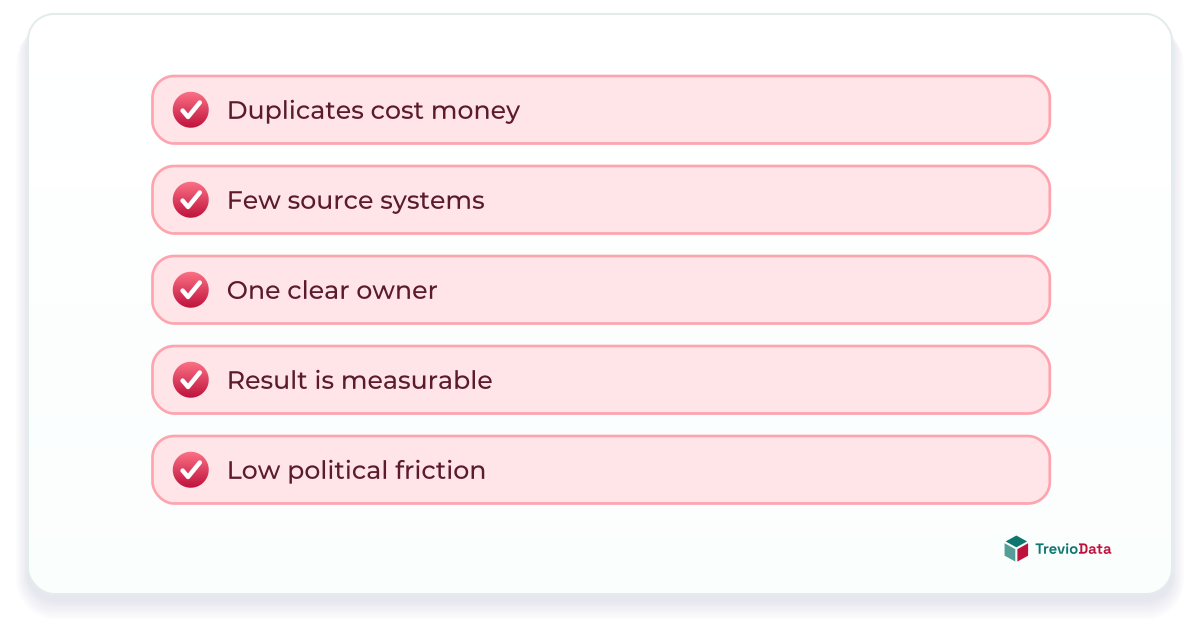
Every company has four or five candidate domains: customers, products, suppliers, locations and sometimes employees or assets. You cannot fix all of them first. Score each one on four things: how many records are wrong, what a wrong record costs, how many systems create it and how hard it is to get agreement on a definition.
The costs are usually easier to find than you expect. Ask finance how many invoices are corrected each month. Ask logistics how many parcels come back. Ask marketing how many emails bounce or reach the same person twice. Multiply by a per-case cost, even a rough one, and you have a business case that a budget holder can read.
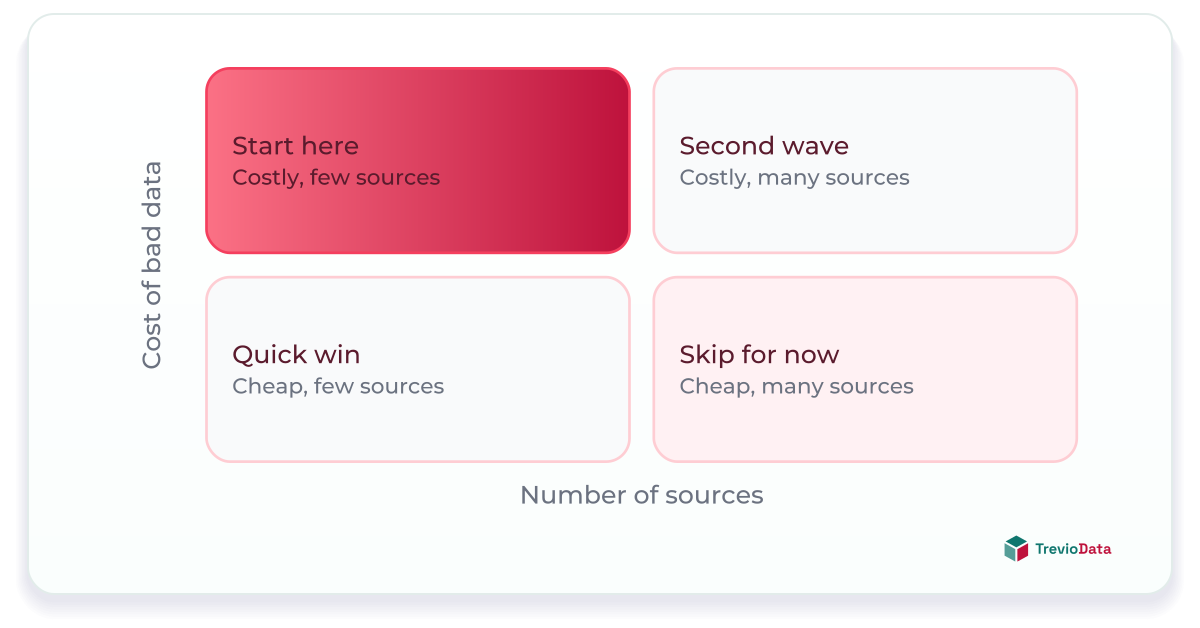
Be honest about political difficulty. Customer data is nearly always the most valuable and the most contested, because sales, finance and support all define a customer differently. If you expect a long fight, a supplier or product domain can give you a quick, visible win while you build the case for the harder one. My master data management use cases article shows what each domain tends to pay back.
Phase 2: Name Owners Before You Name Tools
A golden record is a set of decisions: what counts as a duplicate, which address is current, which product name is official. Someone has to make those decisions, and it cannot be the IT team. The most common reason a clean-up decays within a year is that nobody owns the rules once the project team leaves.
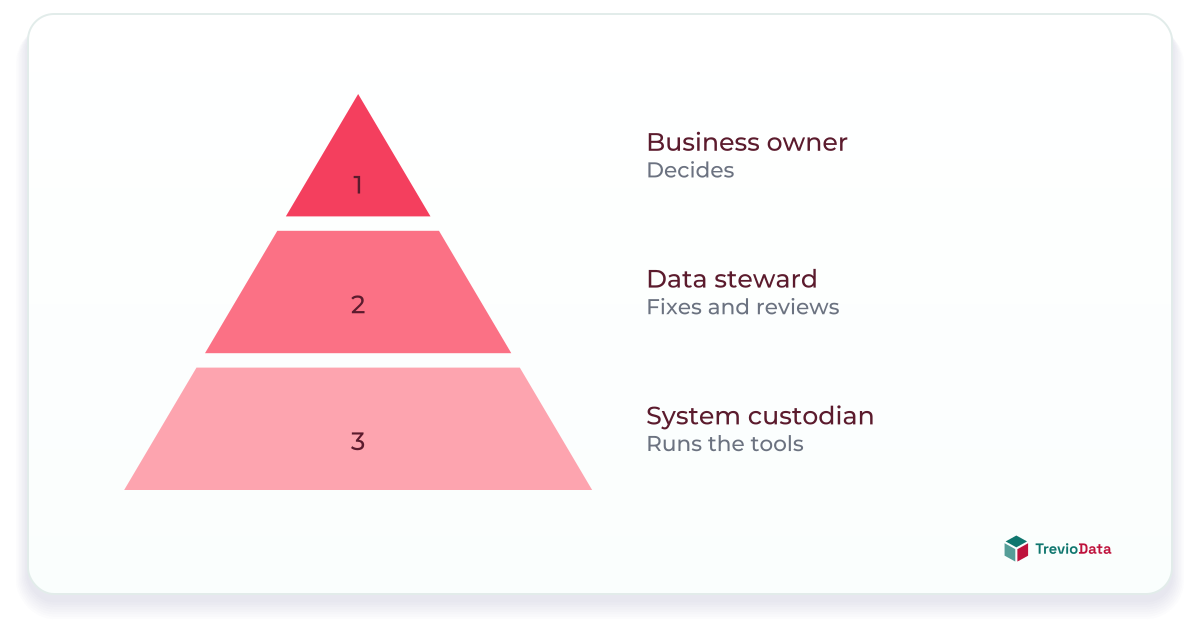
Give each domain a business owner with authority, a steward who works through the daily queue and a technical custodian who runs the systems. In a mid-sized company that can be three people part-time. Write down the escalation path as well: when two stewards disagree on a merge, who decides, and how fast?
This is also where the line to data governance gets drawn. MDM defines and maintains the record, while governance sets policy around it. If you have no governance function yet, keep it light and tie it to the first domain. The data governance consulting service goes deeper if you need a company-wide program.
One practical tip on stewards: pick people who already fix records informally. Every company has someone in customer service or finance operations who knows which accounts are duplicates and which addresses are stale. That person already has the judgment you need, and giving them a proper queue and the authority to decide turns hidden effort into a managed process. It also builds goodwill, because the people closest to the problem finally get tools and a mandate instead of another report to read.
Phase 3: Define the Golden Record Before You Merge Anything
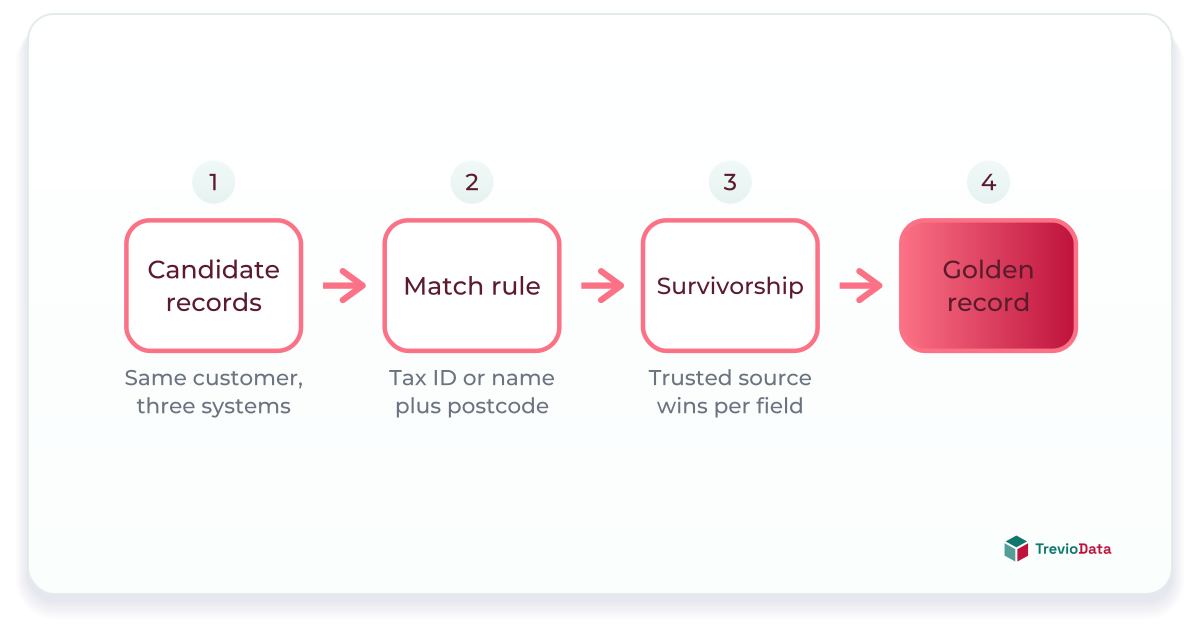
Three artifacts make up the definition, and I ask clients to produce them on paper before any tool is configured.
- The model. Which attributes belong to the record, which are mandatory and which formats apply. A customer needs a legal name and a country, for example, but maybe not a fax number.
- Match rules. What makes two records the same entity. Exact matches on a tax ID are easy. Fuzzy matches on name and address need thresholds, and you should expect to tune them.
- Survivorship rules. When two records disagree, which value wins: the most recent, the most trusted source or the most complete?
Test the rules on a sample of a few thousand real records before you scale. Print fifty pairs that the rules would merge and fifty that they would keep apart, and let the steward mark the mistakes. Two or three rounds like this are worth more than any vendor demo. The master data management framework article lays out the model in more detail.
Phase 4: Choose How the Golden Record Reaches Your Systems
There are four common styles, and the choice shapes your budget more than the vendor name does.
| Style | How it works | Fits when |
|---|---|---|
| Registry | Links records across systems and leaves the data where it is | You need a quick, read-only view and cannot change source systems |
| Consolidation | Builds a golden record in a hub for reporting and analytics | Your main goal is trusted reporting |
| Coexistence | Hub and source systems both edit, and changes sync both ways | Several teams must keep working in their own tools |
| Centralized | Records are created and changed in the hub, then sent out | You can enforce one entry point for a domain |
Most mid-sized companies start with consolidation or coexistence. Centralized gives the cleanest data and the biggest change in how people work, so I usually save it for domains like suppliers or products, where a single entry point is realistic.
Once you know the style, you can decide on tooling. Some companies run the first domain on their warehouse and a steward workflow. Others need a platform from day one. Compare options in my ranking of master data management software, and ask every vendor for a quote that includes implementation. When you are ready to build, the master data management implementation guide covers the sequence.
Phase 5: Measure, Then Expand
Choose three to five metrics before launch and record the baseline. Good starting points are duplicate rate, completeness of mandatory fields, time to create a new record, steward queue size and the downstream cost you used in your business case, such as returned mail.
| Metric | How to measure it | What a healthy trend looks like |
|---|---|---|
| Duplicate rate | Share of records that match another record above your threshold | Falls fast in month one, then flattens at a low level |
| Completeness | Share of records with every mandatory field filled | Rises steadily as capture rules tighten |
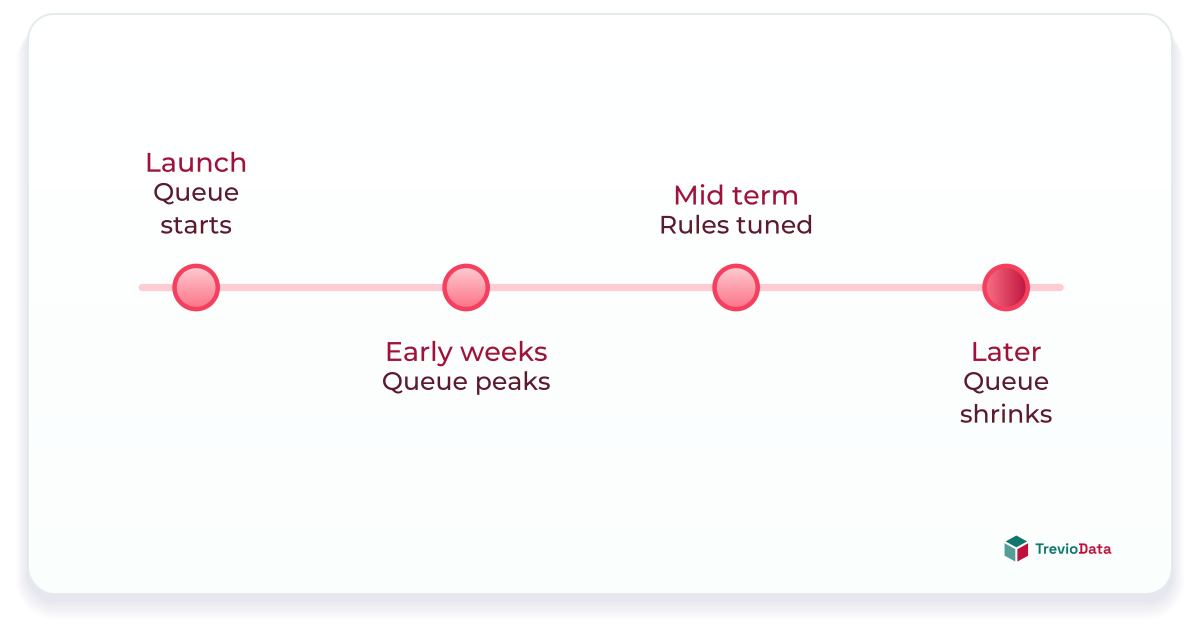
| Steward queue | Open uncertain matches and their age | Peaks after launch, then shrinks as rules improve |
| Cost of bad data | Failed deliveries, corrections, bounced mail | Falls within one or two quarters |
Report these every month to the domain owner. A flat line in the steward queue means the rules need work, and a rising duplicate rate means a source system is still creating bad records. Once the first domain holds steady for a quarter, use the same method on the next one. The master data management best practices article lists the habits that keep results from slipping.
Strategy Mistakes I See Most Often
The first mistake is starting with a platform purchase. The tool arrives, the rules are undecided and the project becomes a configuration exercise. The second is scoping every domain at once. The third is treating MDM as an IT project, which leaves the business without ownership. A quieter fourth is skipping the baseline, so nobody can show that anything improved.
If you recognize two of these, pause and rewrite phase one. A smaller scope with a clear owner is easier to rescue than a big program with no one accountable.
How to Know Your Strategy Is Ready
Before you commit budget, check that you can answer each of these in one sentence:
- Which domain comes first, and what does bad data in it cost per month?
- Who is the business owner, and who is the steward?
- What are the match and survivorship rules, and where were they tested?
- Which delivery style will you use, and which systems connect first?
- Which metrics will you report, and what are the baselines?
If one answer is missing, that is your next task. Strategy work is done when the first domain can start building, not when the document is long.
Questions About Master Data Management Strategy
What Is a Master Data Management Strategy?
It is the written plan that says which data domains you will master, who owns them, which systems hold the golden record, how records get matched and how you will measure success. It ties MDM to a business problem, such as failed deliveries or conflicting customer counts, so the work has a clear reason and a clear end point for the first phase.
How Long Should a Master Data Management Strategy Take to Write?
For a mid-sized company, two to six weeks is typical, including profiling of the first domain and interviews with the people who create and fix records. If it takes much longer, the scope is probably too wide. Strategy work should end with a first-domain plan, not with a library of slides.
Which Domain Should I Master First?
Pick the domain where bad records cost you the most and where the fewest systems create them. For many companies that is customers or products. Suppliers come first when duplicate vendors cause double payments. Avoid starting with the domain that touches every system, because the first project should be small enough to finish.
Do I Need an MDM Tool to Start?
Not on day one. You can profile data, agree on definitions and name owners with spreadsheets and your warehouse. A platform becomes useful when several systems create the same records and you need workflows and sharing back to applications. My comparison of MDM software shows the main options once you reach that point.
Who Should Own Master Data?
A business leader owns each domain, for example the head of sales operations for customers, and appoints data stewards who handle daily fixes. IT runs the platform and integrations. When IT owns the data itself, rules drift away from how the business works.
How Do I Get Budget for Master Data Management?
Translate the problem into money. Count the hours spent reconciling records, the cost of failed deliveries and duplicate payments, and the campaigns that reach the same person twice. A first-domain business case with a payback estimate is far easier to approve than a platform purchase.
How Often Should the Strategy Be Reviewed?
Review it every quarter against your quality metrics, and rewrite the roadmap once a year or after a merger, system change or new regulation. Domain owners should see duplicate rates and completeness every month, so problems show up before the quarterly review.
Disclaimer: This article is general information, not legal, compliance or financial advice. Check the rules that apply to your data and industry.
Was this article helpful?
Thank you for letting us know.
Camille leads the Trevio editorial team and works with our consultants to turn real client projects into practical guides on data strategy, engineering and governance. Before joining Trevio, she spent 11 years in data engineering and analytics roles. She has since edited more than 300 articles on data management and reviewed pipelines and platforms from over 100 client projects. She is based in Denver, Colorado.