Key Takeaways
- A data architecture strategy states goals, principles, three to five priorities and what you will not do.
- Rank priorities by business value, risk and effort, and say no to the rest.
- A playbook turns each priority into plays with an owner, a measure and a decision gate.
- Keep the document to a few pages and review it twice a year.
A strategy is a set of choices. Most architecture strategies I read are lists of everything the team would like to do, which makes them useless when two projects compete for the same engineers. If you want a second pair of eyes on yours, data architecture consulting often begins with a short strategy workshop.
This guide covers the priorities first, then the playbook. The priorities say where to focus. The playbook says how to act on each one, so the document leads to work and not to applause.
The Strategy on One Page
| Part | What it contains | Length | Owner |
|---|---|---|---|
| 1. Goals | Three business outcomes the design must support | Half a page | Business sponsor |
| 2. Principles | Five to seven rules for technical choices | Half a page | Lead architect |
| 3. Priorities | Three to five ranked priorities, plus a not-doing list | One page | Sponsor and architect |
| 4. Target picture | The layers and main platforms in a simple diagram | One page | Lead architect |
| 5. Playbook | Plays with owners, measures and gates | Two pages | Data lead |
| 6. Measures | Four to six numbers reviewed quarterly | Half a page | Data lead |
Start With Goals the Business Already Cares About
Open with three outcomes written in the language of the business, such as faster month-end close, one view of each customer or lower platform cost. Avoid goals such as modernize the platform, because nobody outside IT can tell whether you achieved it.
I get these by interviewing the heads of finance, sales and operations for thirty minutes each and asking one question: which decision do you make with the least trust in the data? The answers repeat quickly. Two or three themes come up in nearly every company, and those become your goals.
For each goal, record a measure and a baseline. If month-end close takes nine days today, write nine. A strategy without baselines gives you nothing to point at a year later.
Write Principles That Settle Arguments
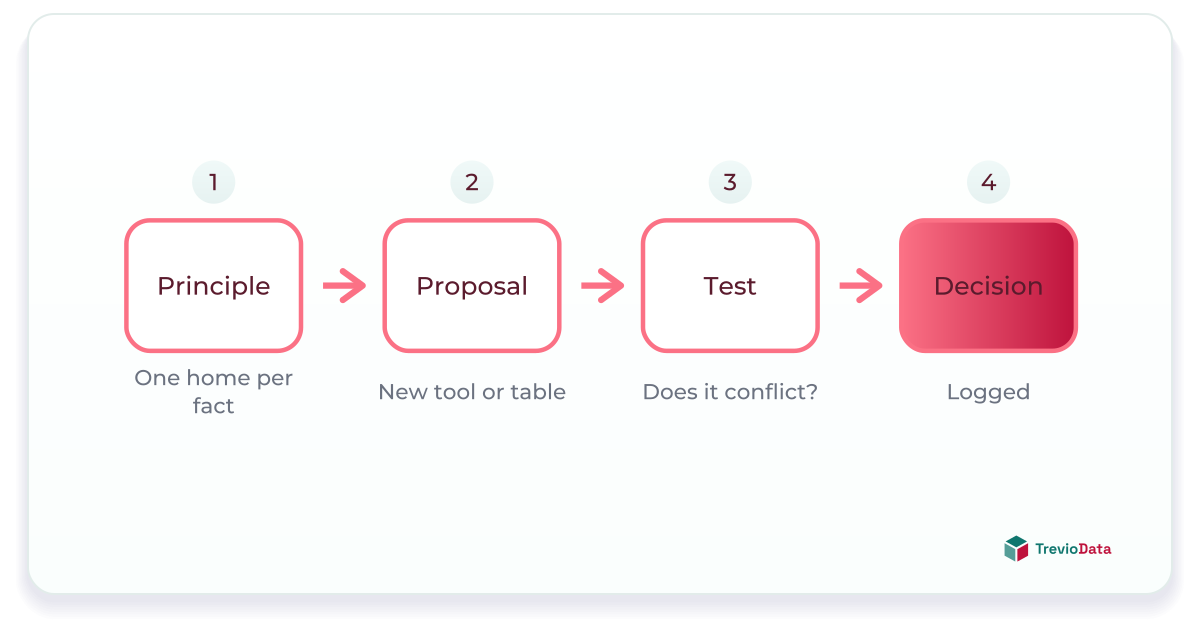
Principles are short rules that guide choices when no one is in the room. A good principle helps you decide something. Buy before build unless the capability sets us apart is a principle. Be consistent is not.
Examples I have seen work: data has one owner, each fact has one home, integrations go through the shared layer, raw data is kept unchanged, sensitive data is classified at design time and every platform choice states its exit cost. Write each as one sentence with one sentence of reasoning. The best-practice habits behind these are in my list of data architecture best practices.
Rank Priorities by Value, Risk and Effort
Gather every candidate project, from a warehouse migration to a naming guide, and score each one from 1 to 5 on three dimensions: business value, risk reduction and effort, where a high effort score is bad. Then rank them. Value and risk count most, and effort breaks ties.
| Candidate | Value | Risk reduction | Effort | Rank |
|---|---|---|---|---|
| Agree core definitions and owners | 5 | 4 | 1 | 1 |
| Replace point-to-point links with a shared layer | 4 | 5 | 4 | 2 |
| Add monitoring and cost alerts | 3 | 4 | 2 | 3 |
| Migrate legacy reports to the warehouse | 4 | 3 | 5 | 4 |
| Evaluate a lakehouse | 2 | 1 | 4 | 5 |
The scores are illustrative, and your numbers will differ. What matters is that you argue about the scores, because the argument surfaces assumptions. Then cut the list at five. In my experience the first cut is the hardest, and the most common reason is a favorite project of a senior person. Show the scores and let the numbers do the talking.
Draw the Target Picture on One Page
The target picture is a diagram of your intended layers and main platforms, with a note on what moves and what stays. Keep it simple: sources on the left, ingestion, storage and modeling in the middle, serving on the right, governance across the bottom. The structure follows the model in my data architecture framework.
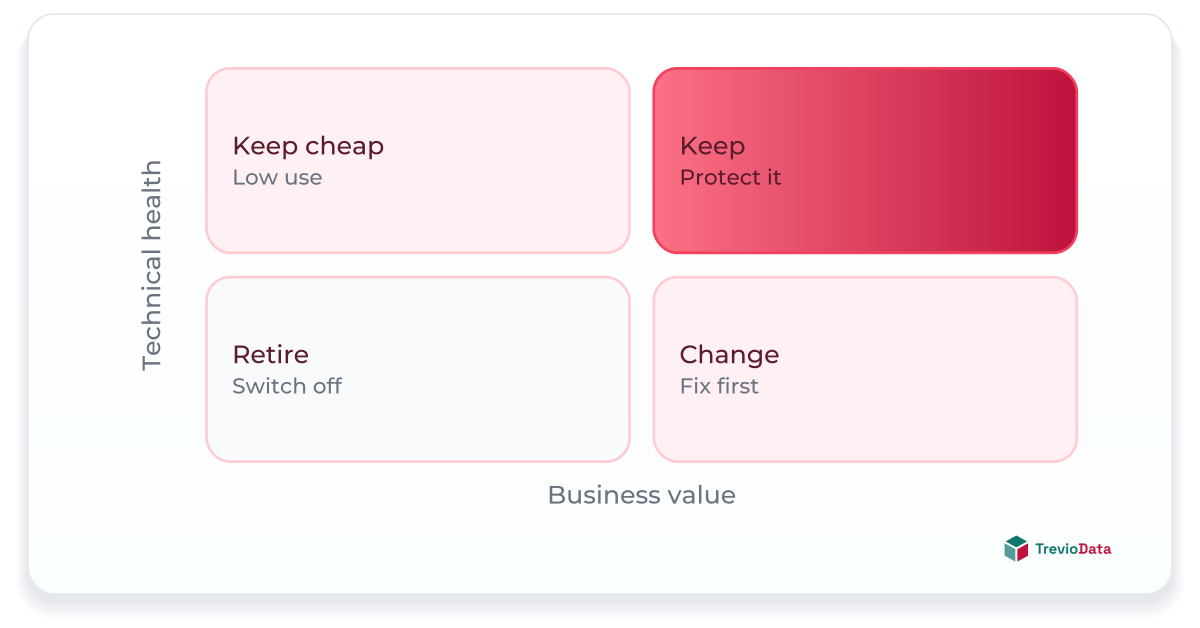
Mark each element as keep, change or retire. This turns the picture into a to-do list, and it makes visible how much of your current landscape survives. Most clients are relieved to see how much does.
The Playbook: Plays for Each Priority
A play is a repeatable move with an owner, a first step, a measure and a decision gate. The gate is a question you answer before the next stage, such as whether the first domain's reports match the old numbers. Write one play for each priority and keep each to a short paragraph.
Play 1, agree definitions and owners. The data lead runs three workshops with finance, sales and operations and records ten metric definitions and five core entities. The measure is the number of reports that use the agreed definitions. The gate is sign-off from each domain owner.
Play 2, build the shared integration layer. The lead engineer picks one noisy source, moves it into the layer and retires the direct links that used it. The measure is the count of direct system links, and the gate is a month of stable runs. Repeat per source.
Play 3, make cost and health visible. An engineer adds monitoring, freshness checks and spending alerts to the platform. The measure is the time between a failure and its detection. The gate is a named person receiving alerts and acting on them.
Play 4, migrate by domain. Choose one domain with high pain and moderate complexity. Run old and new reports side by side until the numbers match, then switch. The measure is the share of reports served from the curated layer, and the gate is a signed-off reconciliation.
Notice how each play is small enough for a quarter. Anything larger gets split. The dated order of these plays belongs in a data architecture roadmap, which turns the playbook into a calendar.
Make the Key Decisions Explicit
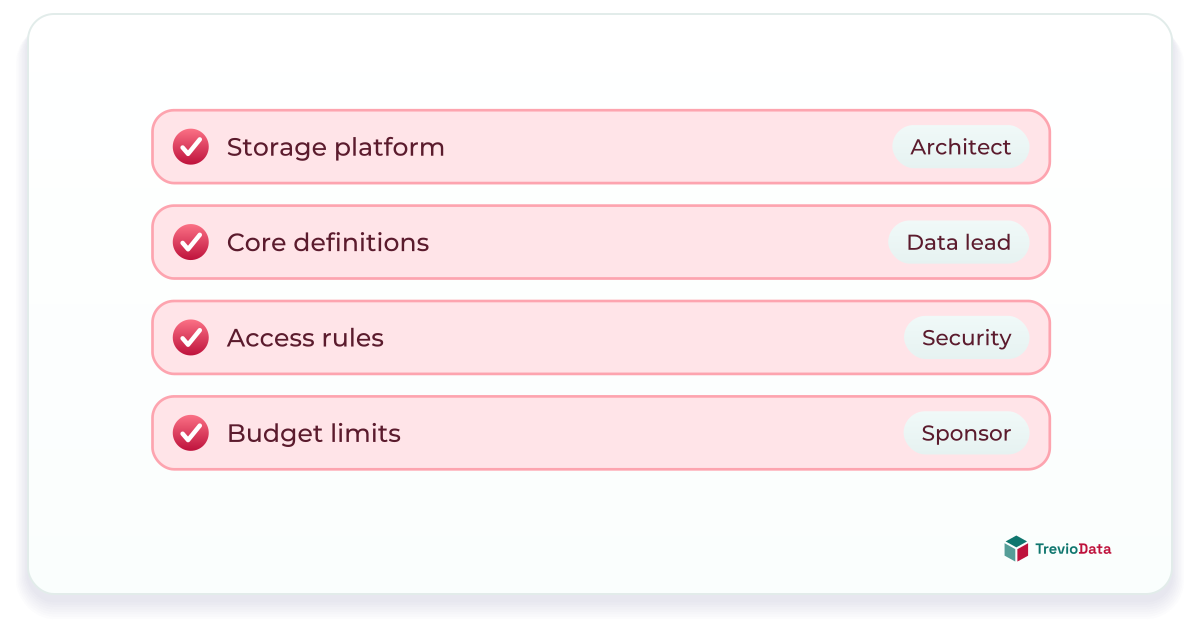
Some choices shape everything after them, so the strategy should name them and say who decides. The usual list has four: warehouse, lake or lakehouse; build, buy or outsource; central or domain ownership; and how much real-time you will fund. For each, write the options, the criteria and the date by which you will decide.
Do not let a vendor decide for you. A tool tends to answer the question it was designed for. If you compare tools, do it against your written criteria, and a ranked list of data architecture tools can serve as the starting set. If the decision involves a large migration or a new platform, get a second opinion before you commit.
Measures and Review Rhythm
Pick four to six measures that tie to your goals. Examples: days to close the month, time to add a new source, share of tables with an owner, cloud cost per user and failed loads per month. Review them quarterly with the sponsor, and spend ten minutes on each: what moved, why and what you will do about it.
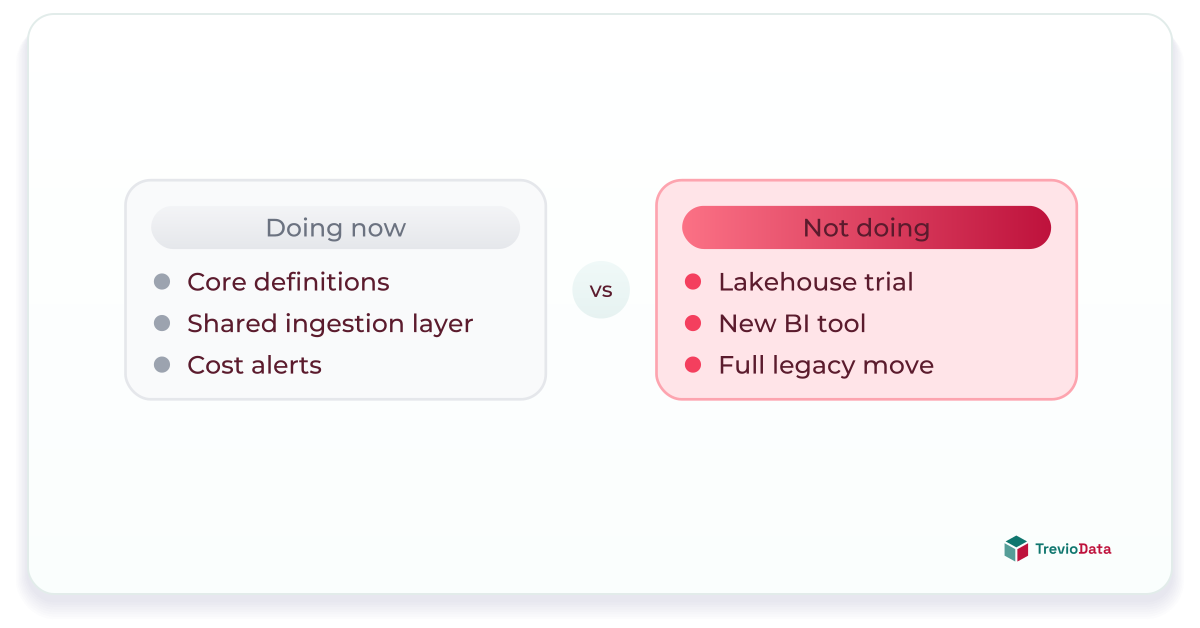
Rewrite the priorities once a year, and update the not-doing list at the same time. If a goal has been met, retire it and say so. Celebrating a finished goal builds the support you need for the next one.
Finally, keep the strategy public inside the company. A document that only the architecture team can find will not guide anyone else. Put it on the intranet, link it from onboarding material and mention it when you turn down a request.
Write It for the Readers You Actually Have
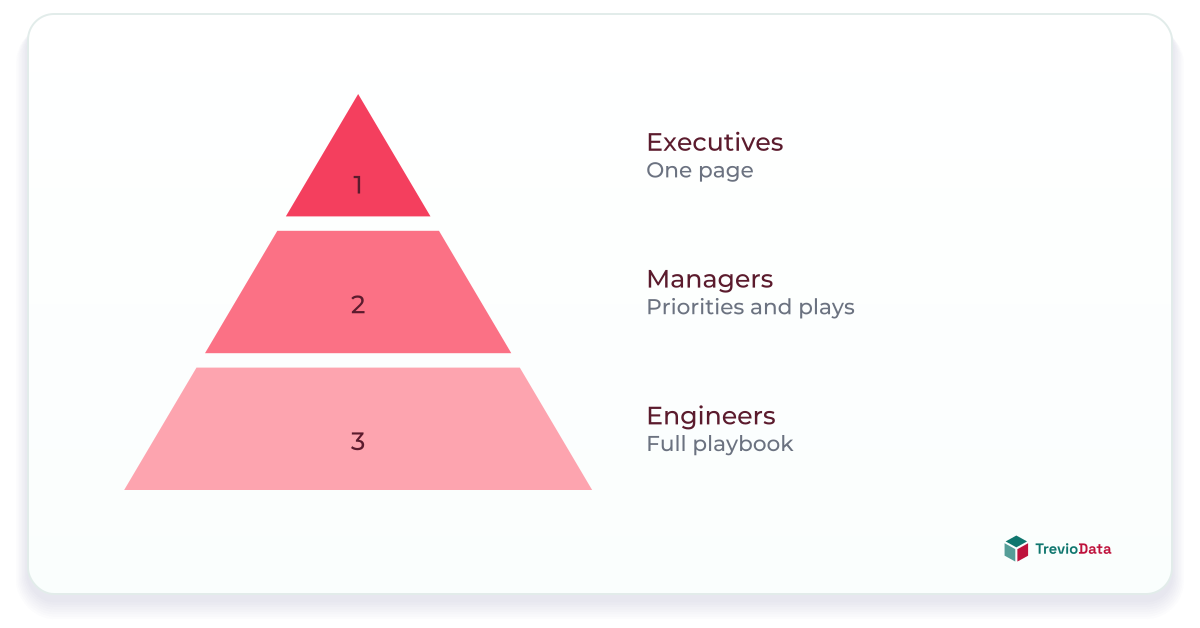
A strategy has at least three audiences, and each reads it differently. Executives read the goals and the priorities, and they want to know what it costs and when they will see a result. Business owners read the target picture and the playbook, and they look for what they must do and what they get. Engineers read the principles and the key decisions, and they look for rules they can apply without asking.
Write the first page for the executives, using the language of the business, and push the technical detail into later sections or an appendix. Then test it: give the draft to one person from each group and ask them to tell you in two sentences what the strategy says. If the answers differ, the document is unclear, and you can fix that cheaply now.
One habit has helped me more than any template. After each review, add a short changes section at the top that lists what moved and why. Readers who know the old version can see the difference in a minute, and new readers learn how the thinking developed.
Mistakes That Make Strategies Fail
- Writing for an audience of architects, in jargon that business leaders skip.
- Listing ten priorities, so nothing is actually chosen.
- Omitting baselines, which makes success impossible to prove.
- Naming tools before the criteria, which locks in a vendor by accident.
- Writing the strategy once and never reviewing it.
If you see more than two of these in your current document, rewrite it in a half-day workshop instead of patching it.
How to Get Started This Month
In week one, interview three business leaders and write down the three goals. In week two, draft five principles and score your candidate projects. In week three, choose the top priorities, write the not-doing list and sketch the target picture. In week four, write the plays, circulate the draft and get sign-off. A few pages and four weeks are enough for a first version, and you can improve it at the six-month review.
Questions About Data Architecture Strategy
What Is a Data Architecture Strategy?
A data architecture strategy is a short document that states which business goals your data design must support, which priorities come first and which principles guide technical choices. It sits above the detailed design and below the company strategy.
How Is It Different from a Data Strategy?
A data strategy covers how the company uses data to create value, including skills, culture and governance. A data architecture strategy narrows to the structure: platforms, models, integration and standards. It should follow from the broader strategy, and in a small company the two can share one document.
How Long Should the Document Be?
Five to eight pages is enough: goals, principles, priorities, target picture, key decisions and measures. If it is longer, people will not read it, and a strategy that nobody reads does not guide anything.
How Many Priorities Should I Set?
Three to five. Every extra priority dilutes effort, and teams with ten priorities finish none of them. Rank them and state clearly what you will not do this year.
Who Should Sign Off on the Strategy?
A business executive and the head of IT or data, together. If only IT signs, business teams treat it as a technical plan. If only the business signs, engineers may not see how to build it.
How Often Should I Update It?
Review it every six months and rewrite priorities once a year. Change it sooner after an acquisition, a platform shift or a change in company goals.
Should the Strategy Name Specific Tools?
Name tools only for decisions that are already made. Otherwise, state the criteria, such as cost model, skills needed and openness of formats, and decide when a project needs one. Tool names age faster than principles.
Note: This article is general information, not legal, financial or tax advice. Figures and examples are estimates based on typical projects, so check current details with your providers and advisers before you decide.
Was this article helpful?
Thank you for letting us know.
Camille leads the Trevio editorial team and works with our consultants to turn real client projects into practical guides on data strategy, engineering and governance. Before joining Trevio, she spent 11 years in data engineering and analytics roles. She has since edited more than 300 articles on data management and reviewed pipelines and platforms from over 100 client projects. She is based in Denver, Colorado.