Key Takeaways
- Start from business decisions, then design in layers with one job each.
- Avoid point-to-point links, keep raw data and model core entities once.
- Naming rules, security and a decision log cost little and save the most time.
- Review the design every quarter, or it will drift away from reality.
Most architecture advice arrives as long reference models. Teams need something shorter: the habits that decide whether a design stays understandable two years later. These eleven come from reviewing many landscapes, and they overlap with what a typical data architecture consulting engagement puts in place.
Each practice has a short do and avoid note, and a few lines on why it matters. I ordered them roughly the way I would introduce them, so start at the top and stop when you have enough to work on.
| Practice | Effort | Typical first step |
|---|---|---|
| 1. Start from decisions | Low | List the ten decisions that matter |
| 2. Design in layers | Medium | Place each system in a layer |
| 3. Avoid point-to-point links | High | Map current connections |
| 4. Keep raw data | Medium | Add a raw zone to storage |
| 5. Model core entities once | Medium | Define customer and product |
| 6. Consistent naming | Low | Publish a one-page guide |
| 7. Separate storage and compute | Medium | Set spending alerts |
| 8. Security by design | Medium | Classify sensitive columns |
| 9. Plan for change | Medium | Move logic into portable SQL |
| 10. Decision log | Low | Write the last three decisions |
| 11. Quarterly review | Low | Book the first session |
The Eleven Practices, With What to Do and What to Avoid
Start from the decisions your business makes
Architecture exists to serve decisions. When you start from them, you can say why each system exists and which ones can go. In my client work, this list is also the fastest way to get an executive to join the conversation.
Do this: List the ten decisions that matter most, such as pricing, inventory or credit approval, and trace the data each one needs.
Avoid this: Starting from a platform choice and hunting for uses afterward.
Design in layers with clear jobs
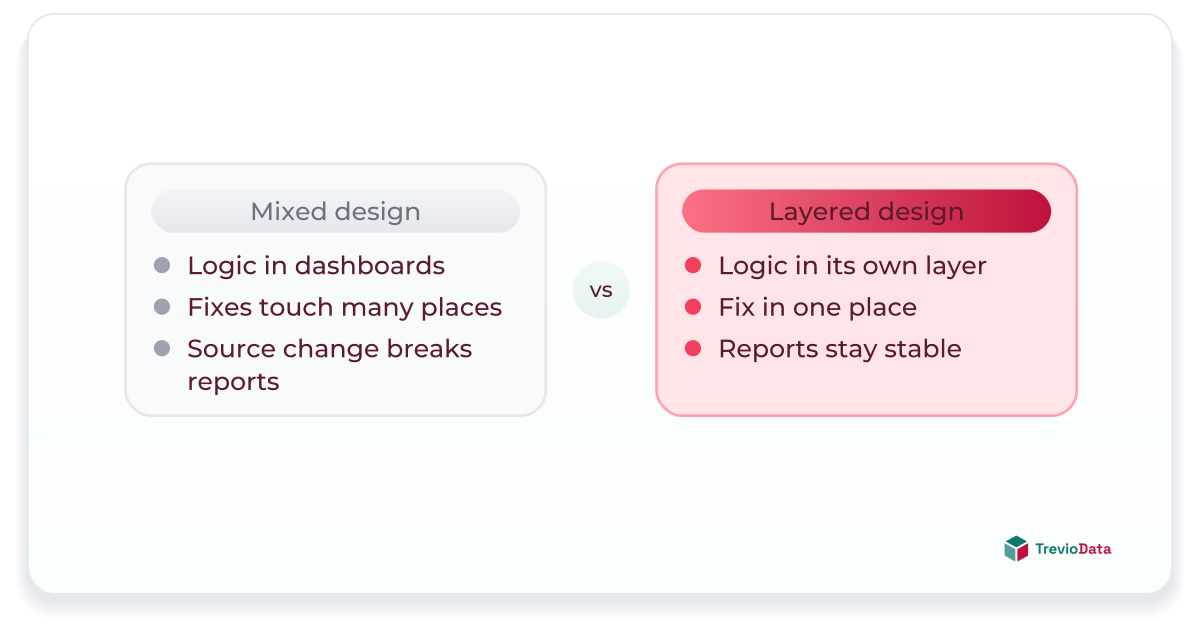
Layers let you change one part without touching the rest. A new source then affects only ingestion, and a new report affects only serving. Mixed layers are the reason small changes take weeks.
Do this: Separate ingestion, storage, modeling and serving, and give each layer one purpose and one owner.
Avoid this: Mixing cleaning logic into dashboards or loading scripts.
Avoid point-to-point integrations
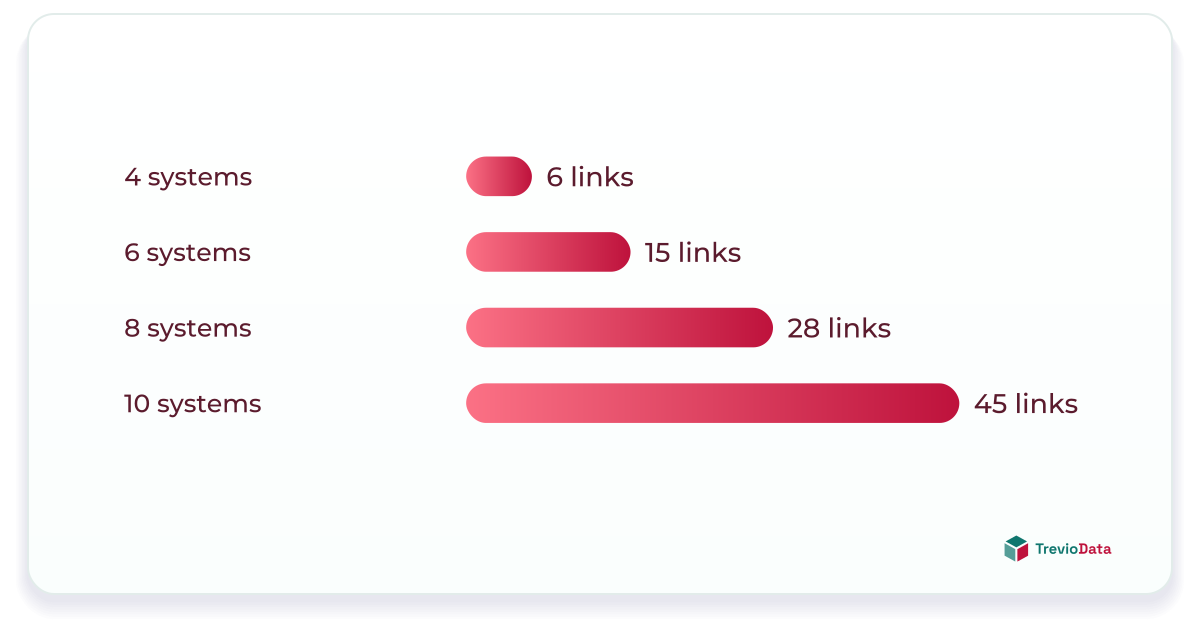
Direct links multiply quickly: ten systems can create dozens of connections, and every one is a place to break. A hub reduces the count to one connection per system and makes changes visible.
Do this: Route data through a shared ingestion or integration layer, so each source connects once.
Avoid this: Letting each team write its own script between two systems.
Keep raw data and keep it unchanged
A raw copy lets you fix a bug in your logic and rebuild history without asking the source system again. It is cheap insurance, and it simplifies audits because you can show where a number came from.
Do this: Store an untouched copy of every source in a raw zone, then build cleaned and curated zones from it.
Avoid this: Overwriting source data during loading.
Model core entities once
Core entities are the spine of your architecture. When they are consistent, joining data across systems is routine. When they are not, every analysis starts with a debate about which table to use.
Do this: Define customer, product, order and account with one structure and one owner each, and reuse them in every project.
Avoid this: Letting every project invent its own customer table.
Name things the same way everywhere
Naming is the cheapest standard to adopt and one of the most useful. A new analyst can guess the name of a column and be right, and automated checks become possible.
Do this: Publish a short naming guide for tables, columns, keys, dates and environments, and check it in code review.
Avoid this: Mixing styles such as CustID, customer_id and CustomerNumber.
Separate storage from compute where you can
Independent scaling keeps a heavy nightly job from slowing down finance, and it makes costs visible by workload. Spending alerts turn a surprise invoice into an email on day three of the month.
Do this: Choose platforms that scale storage and compute independently, and set limits and alerts on spending.
Avoid this: Sizing one large cluster for the busiest hour and leaving it running all day.
Build security into the design
Sensitive columns are easier to protect when the design already marks them. Check legal requirements for your sector and country with your advisor, because the rules differ and change.
Do this: Classify data by sensitivity, apply role-based access by layer and encrypt data at rest and in transit.
Avoid this: Adding access rules after launch, or giving broad access because it is faster.
Plan for change, not for permanence
Tools turn over faster than business logic. If your models and metrics live in portable SQL and clear documents, a platform change is a project. If they live inside one vendor's interface, it is a rewrite.
Do this: Keep interfaces between layers stable and hide platform details behind them, so you can swap a tool without rewriting everything.
Avoid this: Hard-coding vendor features into every report.
Record every major decision and its reason
People leave, and with them the context. A decision log answers why a platform was picked and saves new colleagues from reopening settled questions. A few lines per decision are enough.
Do this: Keep a one-page decision log with the date, the options considered, the choice and what would make you revisit it.
Avoid this: Relying on the memory of the person who made the choice.
Review the architecture on a schedule
Every company changes, and an architecture that does not change with it drifts into fiction. A quarterly review keeps the design honest and gives you a source for the next roadmap items.
Do this: Hold a short quarterly review of changes, gaps and cost, and update the diagrams and standards in the same session.
Avoid this: Treating the design as finished once the first version is published.
In What Order Should You Adopt These?
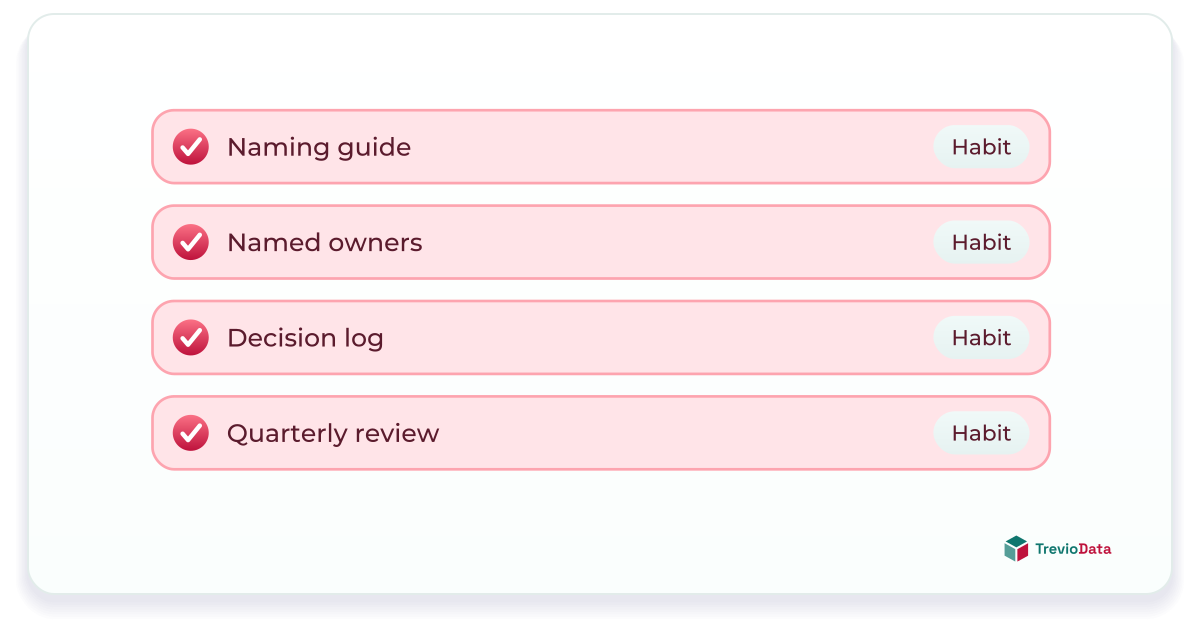
You do not need all eleven at once, and trying to adopt them together is a common reason they all fail. I suggest three waves. In the first month, adopt the cheap ones that change how people talk: starting from decisions, a naming guide and a decision log. They cost hours and create a shared vocabulary.
In the next quarter, tackle the structural habits: layers, a raw zone and one definition for each core entity. These need engineering time and a few honest conversations with the owners of existing systems. In the following two quarters, take on integration cleanup, cost controls and security classification, which are the heaviest items.
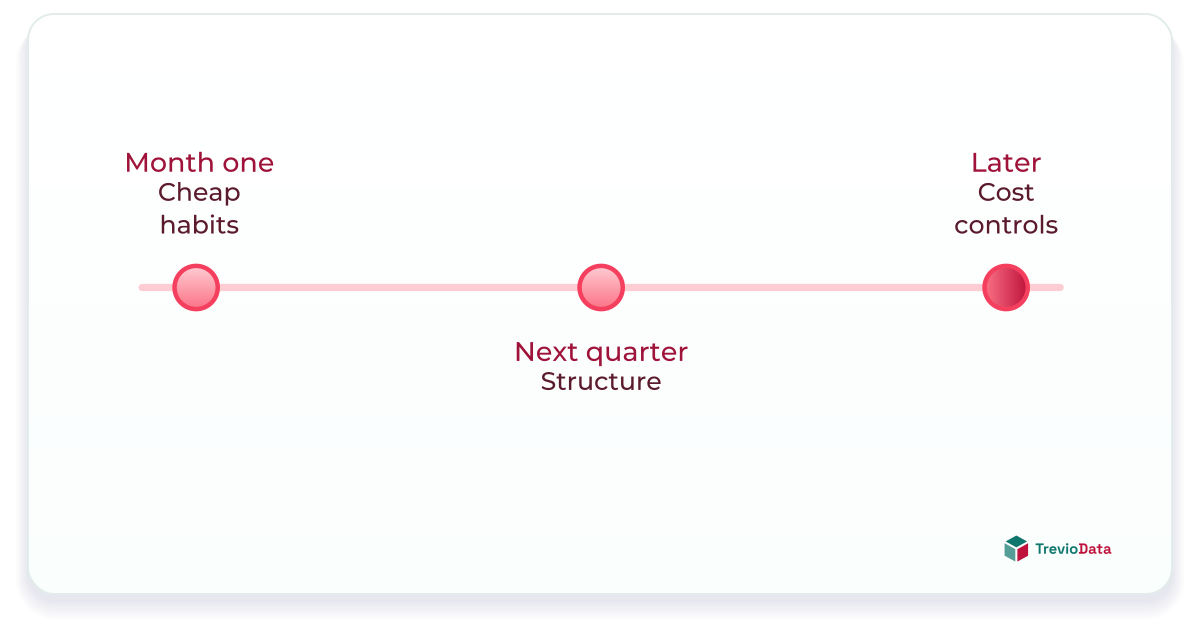
Pick the order by pain. If your cloud bill is the problem, move cost controls up. If audits worry you, move security up. A practice you adopt because it solves a visible problem will survive. One you adopt because a list said so will fade.
How to Tell Whether the Practices Are Working
Practices need measures, or they turn into slogans. Choose a handful of numbers and track them monthly. The table lists the ones I use most.
| Measure | What it shows | Good direction |
|---|---|---|
| Time to add a new source | Health of ingestion and layers | Falling |
| Number of direct system links | Integration sprawl | Falling |
| Share of tables with an owner | Accountability | Rising |
| Reports reading raw tables | Layer discipline | Falling |
| Cloud cost per active user | Cost efficiency | Flat or falling |
| Days since last diagram review | Documentation freshness | Under 90 |
Take a baseline now, before you change anything. Without it you cannot show that the work paid off, and the first question from a sponsor is usually how long the new setup takes compared with the old one. Pair these measures with the dated plan in a data architecture roadmap, so each phase has a number to move.
Where Tools Help, and Where They Do Not
Tools can support almost every practice on the list. Modeling tools keep core entities consistent, diagramming tools keep layers visible and catalogs record owners and descriptions. A ranked overview of data architecture tools shows what each type does and what it costs.
They cannot supply the habit. I have seen teams buy an expensive modeling suite and keep their naming chaos inside it. Adopt the practice with a spreadsheet and a free diagram tool first. When the manual version hurts, you will know exactly what you need from software, and the purchase will have a reason.
Connecting the Practices to Your Strategy
Practices are the daily layer of a larger plan. A strategy tells you why the architecture exists and what the business wants from it, and my guide to data architecture strategy shows how to set those priorities. The practices above turn those priorities into habits. If your strategy says you want faster onboarding of new data sources, practices two, three and four are your direct levers. If it says you want lower platform cost, look at seven and eleven.
The structure beneath all of this is the model in my data architecture framework, with its six layers and the fit score. Use the score to choose which practice to start with, since the weakest weighted layer usually points to the most valuable one.
A Short Checklist Before You Start
Before you roll out any of these, check that the basics are in place:
- A named sponsor who can settle disputes between teams.
- A list of current systems with owners, even if it is rough.
- Agreement on the three practices you will start with.
- One measure for each practice, with a baseline.
- A date for the first quarterly review.
If you cannot tick all five, fix those first. They take a week and decide whether everything after them sticks.
Questions About Data Architecture Best Practices
What Are the Most Important Data Architecture Best Practices?
Start with business questions, keep the design in layers, avoid point-to-point integrations, name owners for every domain and document each decision with its reason. These five prevent most of the problems that make architectures expensive to change.
How Often Should I Review My Data Architecture?
Once a quarter for a short check and once a year for a deeper review. Review it sooner after an acquisition, a major platform change or a new regulation that affects how you store data.
Should I Design for Scale from Day One?
Design for the next stage of growth, not for ten times your size. Choose layers and naming rules that survive growth, but buy and build only what you need in the next year. Over-building costs money and skills you may not have.
How Do I Keep Architecture Diagrams Current?
Store them next to the code or in the same wiki as the standards, give each diagram an owner and a review date, and update them in the same change that alters the system. A diagram nobody owns is wrong within six months.
Is a Data Lake or a Data Warehouse the Better Practice?
Neither is always better. A warehouse suits structured reporting, and a lake suits large raw files and data science. Many teams use both, or a lakehouse, with clear zones and ownership so the lake does not turn into a swamp.
How Do I Get Business Teams to Follow Architecture Standards?
Make the standard the easy path. Provide templates, ready-made tables and a short guide, and show the time it saves. Standards enforced only by review meetings get ignored as soon as a deadline appears.
Can Small Companies Use These Practices?
Yes, in a lighter form. A small company can run ownership, naming rules and a decision log on one shared page. The habits matter at any size, and they are cheaper to start early than to retrofit.
Note: This article is general information, not legal, financial or tax advice. Figures and examples are estimates based on typical projects, so check current details with your providers and advisers before you decide.
Was this article helpful?
Thank you for letting us know.
Camille leads the Trevio editorial team and works with our consultants to turn real client projects into practical guides on data strategy, engineering and governance. Before joining Trevio, she spent 11 years in data engineering and analytics roles. She has since edited more than 300 articles on data management and reviewed pipelines and platforms from over 100 client projects. She is based in Denver, Colorado.